>>1543137I don't know what LCK is but I assume it's kirchoff's laws.
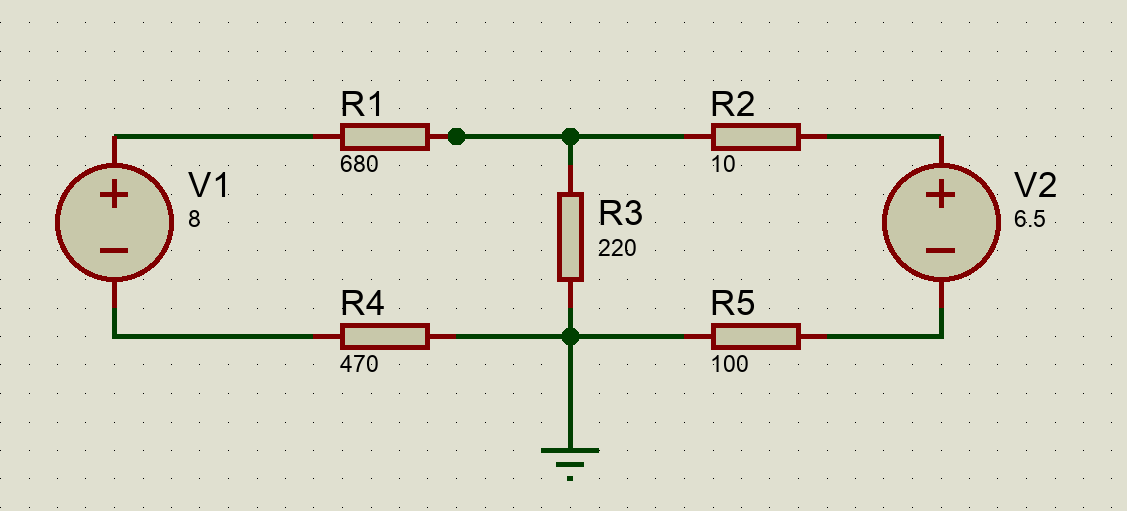
You'll need to create set of simultaneous equations and solve for all the currents.
In the top diagram the potential differences across all components are labelled, as well as the 3 currents in the circuit.
If we know the currents we know the voltages (v_1 = 680*i_1 etc.). There are fewer current variables so lets focus on finding those rather than the voltages.
If we apply the Kirchoff's Voltage law to the purple loop, we end up with an equation containing i_1 and i_3. The orange loop yields an equation in terms of i_2 and i_3. Finally using Kirchoff's current law on the green junction yields an equation with i_1, i_2 and i_3, adding the last constraint needed to make the system of equations solvable. Then we solve for i_1, i_2 and i_3. (Oh and then use Vref to find absolute voltages for all points in the circuit ig)
Intuitively, I like to imagine the purple equation encodes the first branch, and the orange equation encodes the second branch , and the green equation asserts there isn't a third section to the circuit. That is enough to convince me the 3 equations are not redundant and also cover the entire circuit.