[1 / 1 / 1]
Quoted By:
I am trying to solve the following problem. There doesn't seem to be any literature or exercises with this solutions available. The problem is as follows:
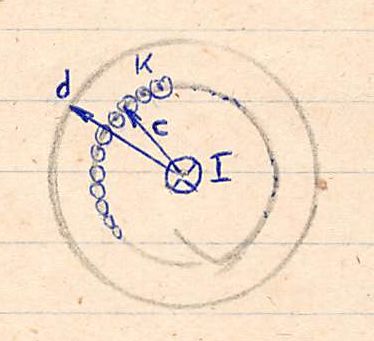
Given is a tilted cylindrical body. The height of the cylinder is b in the z-direction. At ρ = 0, a positive current flows into the cylinder. At ρ = c, a negative current flows out. The sum of the incoming and outgoing currents is 0. The cylinder has a conductivity σ. The radius of the cylinder is d.
The task is to determine the electric field inside the cylinder.
__________________________
The following items were recently processed:
- The dependence of this problem does not depend on phi because rotational symmetry exists.
- In the rho direction, the usual Bessel functions are used.
- In the z direction, non-orthogonal functions are used.
- The linear relationship for the potential is established.
- The formula E = -grad(V) will be used to derive the linear relationship for the potential into its components
- The electric field in the z and rho directions is set up in a linear relationship.
__________________________
What's missing now:
- Which constants must be eliminated due to this arrangement? In his own opinion, it should be possible to eliminate the constants using the normal derivative but how?
- What would be the next steps to obtain an equation for the components of the respective electric field?
Given is a tilted cylindrical body. The height of the cylinder is b in the z-direction. At ρ = 0, a positive current flows into the cylinder. At ρ = c, a negative current flows out. The sum of the incoming and outgoing currents is 0. The cylinder has a conductivity σ. The radius of the cylinder is d.
The task is to determine the electric field inside the cylinder.
__________________________
The following items were recently processed:
- The dependence of this problem does not depend on phi because rotational symmetry exists.
- In the rho direction, the usual Bessel functions are used.
- In the z direction, non-orthogonal functions are used.
- The linear relationship for the potential is established.
- The formula E = -grad(V) will be used to derive the linear relationship for the potential into its components
- The electric field in the z and rho directions is set up in a linear relationship.
__________________________
What's missing now:
- Which constants must be eliminated due to this arrangement? In his own opinion, it should be possible to eliminate the constants using the normal derivative but how?
- What would be the next steps to obtain an equation for the components of the respective electric field?
